Chapter 2: The Echo of Division
In the heart of the Bible Belt, a kaleidoscope of denominations paints the landscape, each with its own distinct identity. Within a mile, you'll find Baptists, Methodists, Pentecostals, Holiness churches, and more – a dozen steeples piercing the sky within a few blocks. Each steeple stands as a testament to the town's spiritual diversity. Roman Catholic churches, however, are confined to bigger cities. If they exist in smaller towns, they're usually on the outskirts. There was never more than one Roman Catholic Church in the smaller counties, if there was one at all. I never knew anyone who attended. Each building claims the same New Testament, Jesus, and promise of heaven. However, none of them worshipped together. Unity was a myth, and division was the very air we breathed. We're taught to see it as proof of conviction, each congregation holding the line against error. As I grew older, the clamor of differences began to resemble echoes in a canyon, repetitive and unyielding. The same words, bouncing off the walls of our own certainty. Why did Jesus demand that we be one, but we were many? This question seems unanswerable.
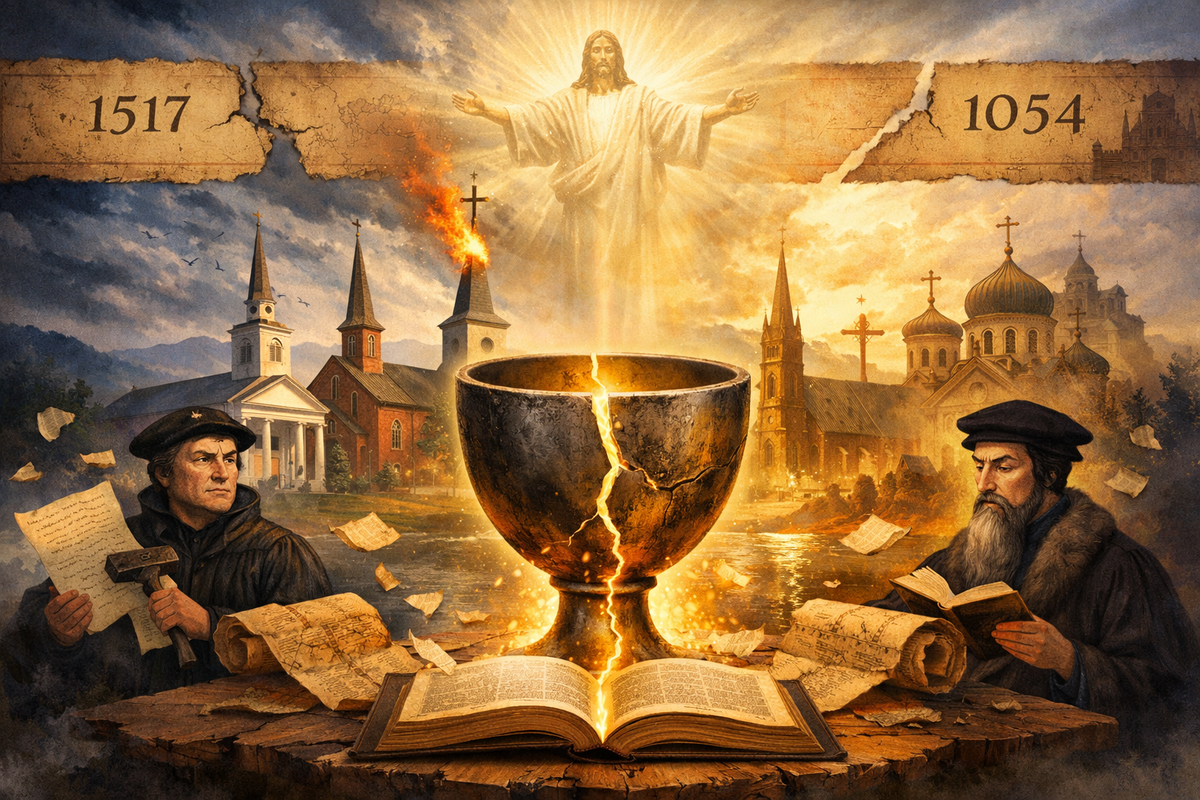
When I first studied the Protestant Reformation, I thought I'd found the source of the echo. The story was presented as a straightforward battle between good and evil, with Martin Luther challenging the Roman Catholic Church's corruption. John Calvin sharpened doctrine's edges. Both men were rescuing truth from a fallen church. They were praised for bringing light to the darkness. I cheered for them.Their courage was undeniable. Their story gave me pride. However, as I delved deeper into the primary sources, the glorified narratives began to unravel, revealing specific complexities and contradictions, such as differing theological interpretations and political motivations, that were previously glossed over. The tale felt too neat, too tall. Where had the rest of the story gone? What events and developments shaped the Church in the 1500 years before these men existed? I began to sense that history itself had been divided. It seemed split down the middle like a cracked chalice. In my textbooks, the narrative of reform shone brightly, overshadowing the preceding history, possibly due to a focus on dramatic events over gradual developments. But a chalice, I thought, is meant to hold wine, symbolizing the unity and continuity of faith, not to be broken This reflects the fragmentation and loss in the Church's history. If the Church was the vessel of faith, what essential elements were lost or transformed in its fragmentation?
The more I studied, the more I saw how sola Scriptura had become both torch and sword. It brought light, but also cut away the memories that held believers together. In seeking purity, we lost continuity. In studying the Bible alone, our only authority, we had forgotten the practices from the Church that preserved it. I'd stare at timelines of councils and schisms, tracing the threat backward to its snapping point. Names blurred into centuries: Wittenberg, Zurich, Geneva – all promising renewal, each leaving smaller pieces behind. I wanted to believe reform was healing, but I could see the divisions growing deeper and more painful, festering with each attempt to mend them. Even amid fracture, I could hear something faint and persistent. It sounded not from one steeple, but from the distance of time itself. It did not ring from those steeples in town. It was steady, sorrowful, and unbroken. It sounded a reminder that the Church still moved over the face of the deep.
It wasn’t until 2013 that I learned what "Catholic" meant. It wasn’t in a classroom or a book where I learned what Catholic meant. I learned it on a podcast while cleaning the house. The host was talking about the history of the early Church. This was something that I’d put on background noise while I folded laundry. The host said it casually, “The word Catholic means 'universal.'" I don’t even recall who I was listening to, but that moment changed everything. I stopped, mid-sweep, feeling something settle deep inside me. A door I hadn’t known existed had quietly opened. "What do you mean "universal?", I thought to myself. This was the moment I began unlearning what I thought I knew and learning again what the Church truly was. It would be a strange journey.
After that first revelation about the meaning of the word Catholic, I didn’t run toward Rome. After that first revelation, I plunged headfirst into what I called "truth-seeking," driven by a desire to challenge and understand the roots of Catholicism. I devoured articles, watched videos, and read blogs about the "pagan roots" of Catholicism. I had an apparent bias in my research. Even Christmas was suspect. For years, I wouldn’t have a Christmas tree in the house. We received so much backlash from our family that we just “knew” it was the right choice. After all, the pastors always say that you get the most rejection when you are on the side of God, right? Instead, we celebrated Chanukkah because that is what Jesus also celebrated. I wrote blog posts warning others about the pagan roots of holidays, convinced I was being faithful. Even church became uncomfortable. Every sanctuary, hymn, and stained glass piece looking Catholic to me. There was so much in every church that was taken from Catholic tradition and they could not see it. This bothered me. Because I believed Catholicism was a distortion, I felt surrounded by compromise. I thought I was aligning with the Reformers, defending the purity of the Gospel, while championing the truth against tradition. Because of this, I had a hard time finding a church and stopped attending all together for several years. "I could do this on my own!," I reasoned. Only later would I realize that I had it all backwards. I was standing inside the cracked chalice, within the crack itself, holding on to the wrong side.
Even in that season of suspicion, God was at work. Boy, was He at work in me. I was convinced the Lord’s Supper wasn’t just symbolic. I at least had that right. Without the knowledge of tradition, I tried to piece it together myself. I began keeping Passover, reasoning that if this was what Jesus celebrated, then I should too. Looking back, I see God leading me closer to the truth of the Paschal mystery, but I was relying on my own understanding. My understanding was incomplete. I was seeking with only half of the map. I was totally unaware of the early Church father's practices, Jewish roots, and truth of the Last Supper. My sincerity was genuine, but my framework was fragile. I held a broken mirror like a child, trying to reassemble the shattered reflection, unaware the original had never been lost. It was hidden, in plain sight, within Catholic tradition.
Years passed, and I still couldn’t find a church that felt like home. My soul was restless like Augustine’s. It searched, circling the same unanswered longing. I visited congregations, but nothing settled. Every sermon echoed familiar fragments, and the hollow between them widened. Why could I not be satisfied? My faith was strong, but I could not be at peace. Fecisti nos ad te et inquietum est cor nostrum, donec requiescat in te. Translated this says, "You have made us for yourself, O Lord, and our hearts are restless until they rest in you"[1].
In 2022, we relocated from Eastern Tennessee to Montana. The vast, untamed landscape felt different from the culture I'd grown up with. No one in Montana that I spoke to had heard of a Cumberland Presbyterian or a Missionary Baptist. The horizon stretched differently here, both in landscape and spirit. Everywhere I looked, Catholicism was etched into the land: the missions, settlers, and saints whose names marked the mountains and rivers. To grasp the story of this land, I had to understand the faith that shaped it. That curiosity led me back again to the early Church fathers, this time through the Eastern door. Orthodoxy requires intensive study to understand what it really means. I started studying Orthodoxy, wondering how it differed from Roman Catholicism and what it meant to call oneself “Orthodox.” There was an Orthodox Church in town that sparked my interest. What was an Orthodox? This was a foreign concept. I had only seen one in the larger city and thought you could only go there if you were Greek. I found a podcast on Ancient Faith Radio called At the Intersection of East and West [2]. The host, Dc. Michael, told his own story of conversion from Protestantism to Orthodoxy. It wasn’t defensive or angry. His tone struck me: peaceful, steady, and full of gratitude. I remember thinking how rare it was to hear someone speak about faith without contempt for where they came from. I did not even have a Roman Catholic past but had a lot of contempt for the history indoctrinated into my brain. I couldn't stop listening to this man. The podcast was based in Nashville, Tennessee, not far from where I once lived. Something about that detail made me smile. It felt as if my old world and new had met at a crossroads. I left Tennessee and moved all the way to Montana, just to be enlightened by an Orthodox Deacon in Tennessee? How curious that was to me.
What began as curiosity became fascination. My husband might say that I was borderline obsessed with learning about Orthodoxy. I ordered books, filled notebooks, and followed footnotes late into the night. I learned about icons. They weren’t idols but windows. Veneration wasn’t worship but reverence. Those icons told stories for those who couldn't read. What a beautiful truth. In the teacher world, we call this differentiation. This was differentiation before its time. It was a way for the illiterate to read Bible stories for themselves, through pictures. They kissed them because they loved them so much. This wasn't worship, but veneration. I learned that the saints were not gone, but alive with God. They interceded for us like beloved elders praying for their children. Again, they were not being worshipped. This was easy to accept because I was also taught that once we die, we enter Heaven or Hell. If we are alive in Christ when we die, then certainly this is true! If I can talk to my dead relatives when I miss them, why couldn't I talk to them too? All of the senses are used during Orthodox worship. Worshipping God requires the use of your entire body. Each discovery was both a surprise and a homecoming. It was as though the dark centuries I had been taught to fear were slowly lighting up, one candle at a time.
The more I studied Orthodoxy, the more I felt a profound connection to spiritual truths that resonated with my soul, though I still struggled to articulate them. What was an Orthodox when compared to Roman Catholicism? The fathers I read – Ignatius, Chrysostom, Basil, Athanasius – were the same men cherished in Catholic tradition. The farther back I traced the line, the less divided the story became. East and West were not enemies; they were brothers who had grown apart. In their earlier words, I kept hearing the same refrain of unity, communion, one faith, and one baptism. I loved the reverence of Orthodoxy. I loved the stillness, the mystery, and the sense that heaven leaned close during prayer. Everything was beautiful. The one Vespers we attended felt as though heaven itself opened up and we were there too. Questions began to rise like small persistent tides. If the Church had once been one, which side had kept the fullness of that unity?
It was an uncomfortable realization that I had been lied to my entire life about Catholic practices. Sadly, those who spew the hate from behind the pulpits are usually in ignorance themselves. I wanted to rest within Orthodoxy, but every new discovery only widened the map. I compared the writings of the fathers with the timeline of history and saw how every road, every reform, and every restoration had splintered further from the center. The word "universal" returned to me like an echo. Yet, something in me still yearned for the wider embrace of the word I had first heard sweeping my floor years before: Universal. Catholic. I found myself drawn back to Rome’s history, this time without suspicion. This time I returned with the agenda to understand, not condemn. I wanted to know what Roman Catholics believed about unity, authority, and apostolic succession. What did it mean that Peter had been given the keys? Had I been told the truth about that?Was it only a symbolic gesture? Why do they believe that the Eucharist is the real presence of Jesus?
I started reading sources like Essay on the Development of Doctrine by Newman and Ratzinger’s writings on liturgy. Their logic startled me. It was not triumphal, but tender, and built on the idea that truth grows like a tree, always the same living thing, unfolding over time. The Church, they said, was not an invention; it was an organism, still alive, still guided by the Spirit that had hovered over the waters in the beginning. The more I read, the more familiar it all became. The prayers, the sacraments, even the reverence for Mary that once unsettled me carried the same pulse of love I had been chasing my whole life. I realized I wasn't walking in circles; I was being led in a slow spiral toward the center. Seek and you shall find had an entirely new meaning to me [4]. It was as if I had been blindfolded my entire life, searching for this truth, only for it to be found in the one place I despised.
Each discovery seemed to resonate with a spiritual truth, drawing me into a contemplative state. What had started as research was becoming a relationship. A relationship that I thought I already had. The Church was no longer a subject I was examining; it was something that seemed to be examining me. The more I read, the more I recognized its voice. It was the same cadence that had once called to me from revival tents and Sunday hymns. It was only now deeper, older, and steadier. The stories of the saints filled the spaces that had once been left empty in my childhood faith. Their lives were not just legends; they were answers to questions I didn’t yet know how to ask. I realized the Church had never disappeared into the darkness between the apostles and the Reformers. It had been there all along, praying, writing, serving, bleeding, and believing while quietly carrying the Gospel forward. The “pagan roots” I once feared began to look less like corruption and more like continuity with the Church taking up the symbols of the world and redeeming them. I saw that the human story and the divine story had never been separate; they were woven together. I stopped writing about what I thought was wrong with modern Christianity and began to listen to what had survived. When I read the Nicene Creed’s one, holy, catholic, and apostolic Church, the words no longer sounded distant or suspect [5]. They sounded like belonging. All divisions I had grieved, and all the searching and the striving, had not been wasted. They were part of the same long mercy that had followed me since childhood: from the cat on the living room floor to the whippoorwills in the trees, from revival tents to ancient cathedrals. God had been guiding me through every echo, every silence, and every question. I had spent so long chasing certainty that I almost missed the truth that had been constant all along; the Spirit had never stopped moving the waters. The Spirit had never stopped moving me.
[1] St. Augustine, Confessions
[2] Ancient Faith Radio, https://www.ancientfaith.com/podcasts/eastwest/
[3] Ibid.
[4] Matthew 7:7-12
[5] Nicene Creed, https://www.usccb.org/beliefs-and-teachings/what-we-believe.