Chapter 1: In the Beginning

My earliest memory seems like a fever dream. I would think it to be a fever dream if I didn’t have a picture to prove the antagonist true. In it, I am crawling across the floor and reaching for a black and white cat. It must have been my cat. It must also have hated me, because I remember the moment it walloped me on the head as if it were Mike Tyson. It was angry at the small human demanding its attention. Then, everything with that memory is black. I don’t remember crying. I don’t remember pain. I only remember that moment of a black and white cat with my tiny arms reaching out to grasp it. I was somewhere between one and two years old. I found a photograph that shows me and the cat together. I often wonder if it was taken the same day. Without seeing that picture, I might have dismissed the memory as a dream.
I would not have known how old I was without the date written on the picture. The question has since been, “How is that my earliest memory?” I forget everything. Ask anyone that I work with. Better yet, ask my husband. If I do not write it down or put it in my phone, you can bet that it will be forgotten. I even forget to look at those tools at times. I can also walk out of one room and forget why I came into the next. This memory was not significant in anyway. It did not alter my life in any way. Why can I recall that instant, but not where I left my keys this morning? I also can’t remember a time in my life that I did not believe in God. I have tried to find a moment when He wasn’t there in my memory. I search my mind for a time when I did not feel His presence. I can’t recall any moment without knowledge of Him. I had a remarkable sense of Someone. Like my arms reaching for the cat, I have always reached for God with an eager reach, not knowing what the response might be.
It is the same with Jesus. As a Christian, I believe God and Jesus are one, but also two. They are inseparable in concept. If you are not a Christian, it can be a confusing. It is even confusing for most Christians to understand the Trinity. We worship only one God, but in three persons. Those three are the Father, Son, and the Holy Spirit. Like an egg with its shell, yolk, and white, the Trinity is one. I came to understand who Jesus was and His importance in my life around the age of six. By then, faith had already taken root as naturally as breathing. It was the air of my childhood. I can recall late night revivals on old hardwood church pews and tents that smelled of dust and earth. The evening heat would be sticky in the Eastern Tennessee hills. The humidity created the perfect prop for the description of hellfire. My Mamaw made sure that I went to every Vacation Bible School she could; even at churches where we didn’t know a soul. She wasn’t what you would call spiritual, though she believed in Jesus. Her faith was stubborn. It was the kind that trusted Him without needing to talk to Him openly. Jesus was never introduced to me as a new discovery. He was simply there in the universe, known to me as a steady presence beneath every sound and season. He was as near and certain as my own heartbeat.
Bible stories were embedded in my heart thanks to all those Vacation Bible Schools and my great grandmother’s nature of storytelling. I loved the parables most of all. They were stories that felt alive with seeds and sheep, coins and lost sons. They all spoke the simple language of things I could see. Long before I understood church doctrine, I understood that stories could hold truth in a way that jars hold light. Jesus, the master storyteller, felt close to the world I knew. I could walk in a field and see both weeds and wheat. I could hold a mustard seed in the palm of my hand and be in wonder of how I would ever have that much faith to move a mountain. How powerful faith must be! He inspired me to write my own stories. In the fourth or fifth grade, I wrote a poem that said:
I love Jesus,
He loves me,
He died on the cross,
So, he could save me.
I was proud of it. Though, not a parable, it was catchy. Catchy enough that I remember it thirty years later. I remember my Mamaw being proud of it and surprised that I came up with that on my own. It was the first poem I can recall writing.
Unfortunately, church was not always as simple as that poem. I remember the preachers who shouted until their faces reddened and veins rose in their necks. They were like auctioneers at a cattle auction, negotiating souls for God. Their voices boomed like thunder rolling through the small sanctuary. The air inside of those services felt electric. It was a cross between hopeful revival and a terrifying reckoning. They would preach the fear of hell into us with pictures of flames and torment that were painted in such detail that I could smell the embers. I was afraid to move from my seat. God, in their sermons, seemed perpetually angry. At any moment he was ready to strike, to smite, and to judge. Like Johnathon Edwards claimed, I was the spider being held over the pit of hell in the hand of God.[1] At any moment, God could decide to drop me. I was at His mercy. I knew how I felt about spiders and what I would do if one was in my hand. I sat small in the pew trying to understand how the same God who told those stories I loved could also drop me into the fire with contempt. I imagined the satisfaction it gave him to do so with such a wretched creature. I was afraid, but I listened.
I also remember pastors who called out the Catholic Church from the pulpit, their voices passionate with conviction. They said Catholics worshipped idols, prayed to statues, and followed men instead of God. I didn’t know any of these "Catholics" then, but the way they spoke made me imagine some far-off people bowing to gold in the dark cathedrals. I simply didn’t want to know any of those people. I didn’t question those accusations. I trusted the learned men behind the pulpit. I was a child who wanted to belong to the side that was right, remembering that I was only kept by God’s mercy. Like all good children afraid of the wrath of God, I avoided those “pagan” practices.
Belonging and acceptance also had rules. Only the King James Version 1611 was holy enough they claimed. Other Bibles were corrupt, modern, and dangerous. One pastor had a room full of red markers across the forbidden texts. I always wondered what made those Bibles, also written by man’s hand, different than the KJV 1611? Why did God put his blessing on the scribes of the English king and not anyone else? Later, learning of the allegations against King James, this just added to the confusion. Women were also seen as the weaker sex, and therefore, had stricter rules. Women were ordered to wear dresses to church. Some who wore them chose to wear them all of the time, but they had to wear them to church or God was not pleased. This was non negotiable. Hair was measured as holiness. Do you remember the 90’s group TLC? I went through a TLC, cool r&b phase, and chopped my hair off like T-Boz. This was not flattering and I was teased in more than one way. Because my hair was too short, more than once I was called out for it from behind the pulpit. The preacher’s voice would find me from the pulpit, saying a woman’s glory was her hair, teasing that I looked like a boy. I sat ashamed, smiling off the shame, with heat rising up my neck. I wondered what God thought of me now. Would he drop me into the fiery pit? Maybe that heat of embarrassment was the hell fire I could feel from God dipping me so close to the flames for being disobedient. I learned early that the road to heaven was narrow and paved with the right words, the right clothes, the right hair, and the right fear. Even as I tried to please an angry God, I still sensed the gentler One hiding just behind the sermon. He was the one who told stories of mercy, claimed that I could move mountains, and looked for lost sheep like me.
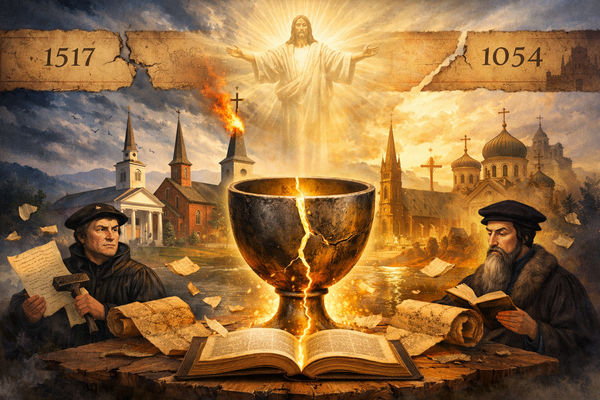
In our denomination, the saints of the church were never mentioned. Only the men in the Bible were mentioned. These men included David, Paul, Peter, John, and others mentioned directly in the Bible. Women, of course, were only mentioned as examples of obedience to those men. Mary’s importance was overshadowed. She was not to be praised or revered, because that would be what those Catholic “pagans” did. We only mentioned her at Christmas. After the last page of Revelation, the story of Christianity seemed to fall into darkness. The church itself seemed to disappear until men like Calvin and Luther arrived for a brief cameo of heroism. In my denomination growing up, there was rarely even mention of them. We lived as if faith jumped from the first century straight into our pews, bypassing two thousand years of men and women who had prayed, served, suffered, and built the body of the Church we inherited. History was not just ignored. It was suspect. Because of sola Scriptura, we were taught that the Bible was the only safe place to stand, that tradition was a swamp that swallowed truths, and that the Holy Spirit would reveal everything we needed to know. My young mind often wondered, “Why couldn’t the Holy Spirit also do that for school so that I did not have to go?” Could I not just pray the knowledge into my head. It might sound like this, "Dear Holy Spirit, please illuminate my mind so that I may master Calculus. Put all the knowledge in my head so that I never have to study the foundations of mathematics. Amen." Instantly, God would reveal all of the calculations and I would never have to put in the work. Problem solved. Unfortunately, this was not the case. Everything outside of Scripture was considered a shadow and superstition. That long, dark silence felt strange. Surely God had not stopped talking after John set down his pen on Patmos. Surely grace had not gone dark for centuries. The sad thing is, growing up, I never questioned this omission. I was ignorant to the hole in the history.
What softened that silence for me were small, secret moments. Some are clear in my memory. I recall sitting at my great aunt’s house in the evening and laying on the trampoline. While laying and looking at the clouds, I would listen to whippoorwills calling through the trees. Sometimes I would try to speak back, mocking their calls. Their low, steady notes reminded me of Jesus and that mustard seed. Not the angry God from the pulpit. The One who lingered, somewhere, in my life. I was drawn to the sky. I could never find those birds while scanning the trees. Then, I would look to the clouds and imagine Jesus coming just as the shouting pastors said He would. However, He would come without their fear; only wonder. I began reading Scripture for myself in my little Precious Moments Bible. It was not the KJV 1611, but the New King James Version. I could understand it much better than the Old English, I just dare not mention that I had this translation. While reading, I noticed confusion between what I was being taught and what was written. Those pastors preached that God measured women by their hair and men by their strictness, but I read that “For the Lord sees not as man sees: man looks on the outward appearance, but the Lord looks on the heart.”[2] It confused me. If God did not care about what we are wearing, why were the people at my church so concerned with what we wore? At an elementary age, this was one of the first questions I wrestled with. Why was the church so sacred and different when they also claimed God to be everywhere?
I also stumbled across the story of Saint Francis in my youth. I learned his story from a horror flick, Stigmata. Even then I wanted to learn the who and why behind the stories. I wanted to know the history and the inspiration. He seemed so different from the angry men in our sermons. I never knew of anyone who would have great riches and give them all away to live homeless. He did not care what he wore. He wore a woolen habit. Something about his story tugged at me. It made me wonder what else was out there in the long silent history of Christianity. Those questions never left me. They hovered at the edge of every sermon and Sunday school lesson, like moths against a porch light. If God had been at work in the beginning, why would He have gone silent afterward? Where had the faithful gone from John to Luther? The older I got, the more I noticed that what was missing in my church’s story was not faith itself. It was missing memory. We knew the verses, but not the lineage. We knew how to quote the prophets, but not how the promise had been carried through centuries of flesh and blood believers. Somewhere between Scripture and our time, a long thread had been cut.
Those thoughts frightened me. To ask questions felt like betrayal. Something in me kept tugging at the knot. I would visit the library, looking for history that we skipped. What I found were fragments. I found monks and martyrs like Joan of Arc. I found women who prayed, not out of submission, but out of passion. The faint outlines of a world that had once known how to worship with beauty as well as with words. I didn’t understand it yet, but the historian in me was being born. I was learning that faith leaves footprints, and I wanted to trace them. I wanted to know how the stories fit together. I needed to know how the flame of belief kept burning through every age.
That longing was quiet, almost hidden. But it was there from the start. It was a soft ache beneath the noise of tent revivals and Sunday doom. I can see it now. It is the way a seed waits under frozen ground. Even then, something in me was already reaching backward through time. It was searching for the roots of the faith I loved. I think often now about how Genesis begins. Everyone remembers the light, “Let there be light,”[3] However, before that, there was water. This is easily missed. “The earth was without form and void, and darkness was upon the face of the deep: and the Spirit of God was moving over the face of the waters.”[4] In the beginning there was no sermons, no certainty, no shouting. There was only water, darkness, and the slow stirring of the Spirit. Creation itself began in mystery. Before there was light to see, there was presence to feel. There was water. My own beginning was like that, too. Faith came to me first not as illumination, but as movement. It was something unseen, hovering over the surface of an unformed heart. I didn’t understand yet what God was shaping in me. I only knew there was depth, and that the Spirit was already there, moving. Like he moved over the water.
[1] Jonathon Edwards, Sinners in the Hands of an Angry God
[2] 1 Samuel 16:7 RSVCE
[3] Genesis 1:3
[4] Genesis 1:2